
Updated on 03/14/2024
Dear readers
My name is Frank and I run a tour operator in Bogota, specializing in custom-made and Colombia luxury travel.
At the end of this guide you will find a list of many other helpful travel guides for Colombia.
Content
Why visit Mocoa?
The city of Mocoa, also known as “San Miguel Arcángel de Agreda”, is the capital of the department of Putumayo and is located in southwestern Colombia.
It borders to the east with the municipalities of Puerto Guzmán and Santa Rosa, to the south with the municipalities of Puerto Caicedo and Villagarzón, to the north with the municipality of Tablón and to the west with the municipalities of San Francisco and Santiago.
Mocoa is an excellent travel destination as it is surrounded by beautiful places with lots of nature, such as various parks and waterfalls, making it an ideal place for those who want to switch off and relax their body and mind.
Facts about Mocoa
- Mocoa is at an altitude of 604 meters above sea level.
- Mocoa has a warm climate with temperatures between 20° C and 28° C.
- The main industries in Mocoa are mining, agriculture and ranching.
- The first school in Mocoa was the Sacred Heart of Jesus School.
- Mocoa has a population of approximately 60,000 residents.
- Mocoa was founded on September 29th by Captain Gonzalo H. de Avendaño.
- Mocoa has an area of 1263 square kilometers.
- Mocoa has the second largest population in Putumayo Department.
- In 1991, Mocoa became the capital of the department of Putumayo.
Tourist attractions in Mocoa
Here are some of the city’s top attractions:
General Santander Park
General Santander Park has large green spaces and palm trees native to Africa.
Also, in the park you can see the bronze statue of General Francisco de Paula Santander.
The park is located in the center of the city, surrounded by the Putumayo Governor’s Office, the Mocoa Mayor’s Office and the San Miguel Arcángel Cathedral.
Monumento a la Raza
The Monumento a la Raza is located at one of the main entrances to the city, more precisely at the roundabout that connects Avenida Colombia and Avenida San Francisco.
Cathedral of San Miguel Arcangel
The Cathedral of San Miguel Arcángel is in front of Plaza General Santander.
This Catholic place of worship houses a wide variety of religious displays.
Golondrino Mocoa waterfall
The Golondrino Mocoa waterfall is located in the locality of Los Andes.
This waterfall is relatively small and no higher than 15 meters.
You can also hike here.
Tourist attractions near Mocoa
Here are some interesting places near Mocoa.
Amazon Experimentation Center
The Centro Experimental Amazónico, also known as Parque Suruma, is located at km 8 on the Mocoa-Villagarzón road.
On an area of 131.6 hectares you can find a large variety of medicinal plants and trees as well as various animal species such as mammals, reptiles and birds.
The Amazon Experimental Center is part of the Society for the Sustainable Development of the Southern Amazon.
Waterfall at the end of the world
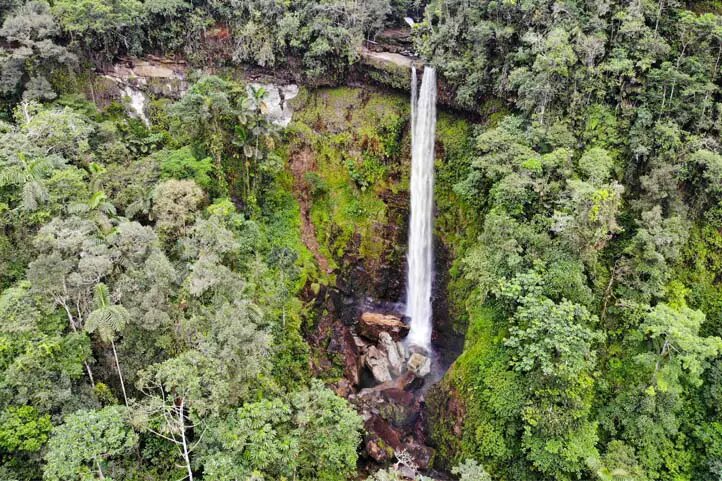
The Fin del Mundo waterfall is located in the locality of San José del Pepino, more precisely at km 6 of the road that leads from Mocoa to Villagarzón.
This waterfall, formed by the Dantayaco stream, is about 70 meters high. To reach the highest part of the waterfall, you have to hike for more than an hour and a half.
In this beautiful place surrounded by nature, you can enjoy 2 natural water pools and also practice canyoning or gorge hiking.
In addition, you can observe various rocks in the form of animals such as bears, pumas, lions and snakes. You can climb further in front of the water basin. There is a rudimentary accommodation where you can stay overnight.
Paway Nature Reserve
The Paway Nature Reserve is an ideal place to interact with butterflies, where you can interact with them and learn about their life cycle.
Besides the butterflies, you can also admire different species of birds and a natural pond formed in a small stream.
The Paway Nature Reserve is located by the bridge over the Pepino River, on the Mocoa-Villagarzón road.
Ojo de Dios waterfall
The Ojo de Dios waterfall is located very close to the Fin del Mundo waterfall, at km 6 of the road that connects Mocoa to Villagarzón.
This waterfall is about 35 meters high. Here you can practice canyoning.
Canyon of the Mandyaco River
The Mandyaco Gorge is located at kilometer 25 of the Mocoa-Ipiales road, very close to the bridge that connects the departments of Putumayo and Cauca.
Here you can hike through the rock formations of the canyon and also take a canoe trip down the river.
Churumbelos National Park
Churumbelos National Park is just 10km (6.2 miles) from Mocoa.
This park is ideal for nature lovers as the vegetation here is very lush.
Archaeological Park of Rio Vides
The Rio Vides Archaeological Park is 14 km (8.6 miles) from Mocoa.
At this site there is a multitude of petroglyphs that were engraved more than 600 years ago and appear to belong to the Acurawa tribe.
Indian Falls
The Salto del Indio, also known as the Indian Waterfall, is located 10 km (6.2 miles) from Moca, very close to the municipality of Villagarzón.
This waterfall is small as it is only 7 meters high.
Urcusique Caves
The Urcusique Caves are an ideal place for adventure seekers as they can come into contact with a wide variety of animals that live in this habitat.
The caves are located very close to the main road that connects the municipality of Mocoa to the municipality of Villagarzón.
Licamancha Caves
The Licamancha Caves are located in the Serranía de los Churumbelos National Park, on the road that leads from Mocoa to Pitalito.
Here you will find a stream that flows into the Caquetá River and paleontological remains millions of years old.
A wide variety of bats, fish, insects and reptiles can also be seen here.
Hornoyaco Waterfall
The Hornoyaco waterfall is located at km 2 of the Mocoa-Villagarzón road.
This waterfall is about 55 meters high.
If you decide to visit this place, you can hike, rappel and bird watch.
Churumbelos Waterfall
Churumbelos Waterfall is located in Churumbelos National Park.
This waterfall has a height of about 70 meters.
Ayahuasca
The indigenous community offers ayahuasca rituals here.
Best time to visit Mocoa
The best time to visit Mocoa is between May and July, when weather conditions are more favorable to visit and enjoy the city’s various tourist attractions.
Events not to be missed in Mocoa
Here are the top events happening in Mocoa throughout the year that you won’t want to miss.
Water Carnival
The Water Carnival is a festival where the city’s residents throw water at each other for amusement and fun. Various competitions and orchestral performances also take place in General Santander Park.
This festival, which has a tradition of more than 90 years, starts in the morning and lasts until the evening.
The Water Carnival is celebrated on December 28th every year.
Feast of the Ugly King
The Festival of the Ugly King is a competition where the region’s ugliest men compete for victory in various categories such as talent, modeling and speeches.
The Ugly King Festival takes place on December 27th every year.
The folkloric carnival of Mocoa
The Carnaval Folklorico de Mocoa, also known as El Carnaval de Negros y Blancos, is a variation of the mythical Nariño festival, also celebrated in Mocoa in the first days of January.
At this festival, people paint their faces black and perform various performances such as parades, folk dances and comparsas.
Indigenous Carnival
The Indigenous Carnival is an event honoring Mocoa’s indigenous communities such as the Kamsá and Inga.
Various instruments such as flutes and drums are played during this festival.
The indigenous carnival is celebrated a few days before Ash Wednesday in February.
Mocoa’s birthday
The founding of the city is celebrated every year on September 29th. Various concerts and folklore parades take place on this day.
Nightlife in Mocoa
Mocoa has some incredible places to enjoy music and dancing, here are some of them.
Club Salsoteca Sandunguera
Avenida Colombia
Club Salsoteca Sandungera is one of the best bars in Mocoa. If you like salsa, you can’t miss this place because it’s the meeting place for all lovers of this genre of music.
Osvan Rest Bar
Avenida Colombia
The Osvan Rest Bar has good music, alcoholic drinks and the best American hamburgers in town.
El Solar Parilla Bar
Avenida Colombia
The Solar Parrilla Bar offers a wide range of food and alcoholic beverages.
Typical dishes in Mocoa
These are some of the typical dishes that you can find in the city of Mocoa.
Envueltos de choclo
The envueltos de choclo are prepared with corn on the cob, cheese, sugar, salt and egg.
Arazá dessert
Postre de Arazá is a dish made with Arazá pulp, unflavored gelatin, milk cream, sugar and condensed milk.
Rainbow trout
This dish is made with salt, garlic, butter, pepper, vegetable oil, and rainbow trout, a freshwater fish.
Chucula
Chucula is a Chirariot-based drink that contains cinnamon, milk, and cloves.
Envueltos de Yuca
Envueltos de yuca are made with panela, yucca, and cheese, then wrapped in banana leaves.
These wraps are usually served with roast meat and coffee.
Smoked cachama
Cachama Ahumada is a dish made with cachamas, salt, onion and pepper and is usually served with lemon, corn and patacones.
Refresco de Cocona
Refresco de Cocona is a drink made from Cocona, a fruit with a similar flavor to Lulo that grows in tropical areas.
This soft drink also usually contains cloves, cinnamon and sugar.
Tortuga skewers
Pinchos de tortuga are made with turtle meat, vinegar, turtle entrails, peppers, tomatoes, brine, cilantro, and onions.
Tacho
Tacacho is made with pork skin, salt, and chopped onions.
This dish is usually served with coffee.
Yellow yucca
Yuca Amarilla, also known as guacamota, is usually served with smoked cachama, smoked pork ribs and grilled meat.
Refresco de Araza
Refresco de Arazá is a drink made from the Arazá fruit.
Accommodation in Mocoa
These are some of the available accommodations in Mocoa, Colombia:
Hotel Suma Wasi
Barrio el Diviso – Exit to Pasto City Route 45/ Mocoa 860001
CLICK HERE FOR BEST RATES FOR HOTEL SUMA WASI
Hotel Suma Wasi offers its guests very pleasant spaces such as an outdoor pool, a terrace, a garden and 2 restaurants with a wide variety of local dishes.
The rooms have air conditioning, private bathroom, function room, gastrobar, desk, wardrobe, flat screen TV and in some cases even a balcony.
Hotel Suma Wasi is 22 km (13.6 miles) from Villagarzón Airport.
Hotel Mocoa Samay
Colombia Avenue Carrera 9 # 23-108
CLICK HERE TO GET BEST RATES FOR HOTEL MOCOA SAMAY
The Hotel Mocoa Samay has rooms equipped with private bathroom, hairdryer, air conditioning and flat screen TV.
It also has a private parking space and a beautiful terrace with a wonderful view.
Hotel Mocoa Samay is 23 km (14.2 miles) from Villagarzón Airport.
Hotel Patio Bonito
Garden Neighborhood Pinayaco Sector
CLICK HERE FOR BEST RATES FOR HOTEL PATIO BONITO
Hotel Patio Bonito has rooms with private bathroom, flat screen TV, wardrobe and air conditioning.
This hotel also offers its guests a garden, private parking and airport shuttle.
Hotel Patio Bonito is located a few meters from General Santander Park and the Cathedral of San Miguel Arcangel.
How to get to Mocoa
The city of Mocoa is located 633 kilometers from Bogotá, the capital of Colombia. There are several ways to get from Bogotá to Mocoa.
By plane
The quickest way to get to Mocoa is by plane. Villagarzón Airport serves the city of Mocoa and is connected to Bogotá and other cities in the country.
You can fly with different airlines like Avianca or Satena.
The airlines that offer connections are as follows:
Bus
Mocoa has a bus station at Carrera 9 No. 16-75, from where you can travel with bus companies such as Transipiales, Coomotor Florencia, Cootranslaboyana and Cootranshuila.
The journey takes about 16 hours.
The easiest way to buy tickets is via Pinbus.
By car
Another option is to travel by car, although it can be quite long, taking between 17 and 18 hours depending on traffic jams and speed.
Please note that you have to pay about 7 tolls on the route.
The following companies rent cars in Colombia:
- Hertz
- Avis
- ABC
Colombia Travel Guides
Here you will find travel guides for the most popular regions in Colombia, which we have put together during our extensive travels around the country.
- Colombia Travel Guide
- Bogota Colombia Travel Guide
- Medellin Colombia Travel Guide
- Cartagena Colombia Travel Guide
- Santa Marta Colombia Travel Guide
- Cali Colombia Travel Guide
- Coffee Triangle Colombia Travel Guide
- Barranquilla Colombia Travel Guide
- La Guajira Colombia Travel Guide
- Tayrona Park Colombia Travel Guide
- Palomino Colombia Travel Guide
- San Andres Island Colombia Travel Guide
- Providencia Island Colombia Travel Guide
- Casanare Llanos Colombia Travel Guide
- Amazonas Colombia Travel Guide
- Chocó Colombia Travel Guide
- Santander Colombia Travel Guide
- Boyaca Colombia Travel Guide
Travel Guides to Colombia’s Small Towns
Here you will find travel guides for less popular destinations in Colombia. Some of these destinations are even real insider tips and not even known to the Colombians as travel destinations.
- Aguachica Colombia Travel Guide
- Arauca Colombia Travel Guide
- Armenia Colombia Travel Guide
- Barrancabermeja Colombia Travel Guide
- Bucaramanga Colombia Travel Guide
- Buenaventura Colombia Travel Guide
- Canyon Chicamocha Colombia Travel Guide
- El Carmen de Bolivar Colombia Travel Guide
- Caucasia Colombia Travel Guide
- Cucuta Colombia Travel Guide
- Florencia Colombia Travel Guide
- Ibagué Colombia Travel Guide
- Inirida Colombia Travel Guide
- Ipiales Colombia Travel Guide
- Magangue Colombia Travel Guide
- Manizales Colombia Travel Guide
- Mitu Colombia Travel Guide
- Mocoa Colombia Travel Guide
- Monteria Colombia Travel Guide
- Neiva Colombia Travel Guide
- Palmira Colombia Travel Guide
- Pasto Colombia Travel Guide
- Pereira Colombia Travel Guide
- Popayan Colombia Travel Guide
- Puerto Asis Colombia Travel Guide
- Puerto Carreno Colombia Travel Guide
- Quibdo Colombia Travel Guide
- Riohacha Colombia Travel Guide
- San José del Guaviare Colombia Travel Guide
- Sincelejo Colombia Travel Guide
- Sogamoso Colombia Travel Guide
- Tulua Colombia Travel Guide
- Tumaco Colombia Travel Guide
- Tunja Colombia Travel Guide
- Turbo Colombia Travel Guide
- Valledupar Colombia Travel Guide
- Villa de Leyva Colombia Travel Guide
- Villavicencio Colombia Travel Guide
- Yopal Colombia Travel Guide
