

Dear readers
My name is Frank and I run a tour operator in Bogota, specializing in custom-made and Colombia luxury travel.
At the end of this guide you will find a list of many other helpful travel guides for Colombia.
Content
ToggleWhy visit Pereira?
The city of Pereira, popularly known as “La querendona, trasnochadora y morena”, is the capital of the department of Risaralda and is located in the valley of the Otún River in the Central Andes mountain range.
The city borders to the east with the department of Tolima, to the south with the department of Quindío, to the north with the municipalities of La Virginia, Marsella, Dosquebradas and Balboa and to the west with the department of Valle del Cauca.
Pereira is an excellent tourist destination as there are many beautiful and historical places to visit, great gastronomic offer and of course a great atmosphere, especially in August when the harvest festival is celebrated.
Facts about Pereira
- Pereira is also known as “La perla del Otún” and “The city without doors”.
- The main shopping centers in Pereira are Centro Comercial Pereira Plaza, Victoria Centro Comercial and Parque Arboleda Centro Comercial.
- Pereira is located at an altitude of 702 meters above sea level.
- Pereira is the most populous city in the coffee-growing region.
- Pereira has a warm climate with temperatures between 17ºC and 26ºC.
- The main economic sectors of Pereira are trade, tourism and coffee production.
- Pereira is divided into 19 municipalities.
- The area where the city of Pereira is located was inhabited by the tribes of the Quimbaya and Pijao cultures, well known for their goldsmithing skills.
- Pereira was the birthplace of great athletes and painters.
- The name of the city of Pereira comes from the lawyer Francisco Pereira Martínez, who was very close to the struggle for independence.
- Pereira is considered one of the cities in Colombia with the largest proportion of green spaces.
- The Anthem of Pereira was created by the poet Julio Cano, who was responsible for the lyrics, and the Santander master Luis A. Calvo, who was responsible for the music.
- Pereira has a population of approximately 500,000 inhabitants.
- Pereira was founded on August 30, 1863 by Jesús Maria Ormaza, Guillermo Pereira, Elias Recio, Remigio Antonio Cañarte and others.
- Every year Pereira is among the 7 cities in Colombia with the highest industrial and economic growth.
- Pereira has an area of 704 square kilometers.
Tourist attractions in Pereira
Here are some of the city’s top attractions:
Plaza de Bolivar
Carrera 8a # 19-67
Plaza de Bolivar, also known as Plaza de los Mangos, is located in the center of the city.
This square is surrounded by restaurants and features rest areas and of course the iconic monument of the Naked Bolivar.
Also next to the plaza is the Cathedral of Nuestra Señora de la Pobreza.
Viaduct Cesar Gaviria Trujillo
Named after the former President of Colombia and inaugurated on November 19, 1997, the César-Gaviria-Trujillo Viaduct has linked the city of Pereira with the municipality of Dosquebradas since its inauguration in the late 1990s.
This metal construction with 177 steel cables has an extension of more than 700 meters and a height of more than 50 meters.
The César Gaviria Trujillo Viaduct over the Otún River is considered one of the largest cable-stayed bridges in South America.
The importance of this viaduct is such that it was awarded the National Architecture Prize in 1998.
Naked Simon Bolivar Monument
The Nude Simon Bolivar Monument is located in Plaza de Bolivar.
This bronze sculpture by Rodrigo Arenas Betancourt weighs 11 tons and is 8.5 meters high.
The Nude Simon Bolivar Monument was created to commemorate the city’s centenary in 1963.
Olympic Village
The Olympic Village, also called Plazoleta Risaralda, houses a 15-meter-high obelisk and various sports facilities such as the Hernán Ramírez Villegas Stadium, the Alfonso Hurtado Sarria Velodrome, a martial arts coliseum, a motocross track, a racquetball court and various Olympic-size swimming pools.
The 2005 Bolivarian Games were held in this Olympic village to the west of Pereira, very close to Matecaña International Airport.
Matecaña Zoological Park in Pereira
Pereira Matecaña Zoological Park is on the road to Matecaña Airport.
In this themed zoo you will find more than 800 species of animals, including hippos, ostriches, jaguars, flamingos and many more.
You can also participate in various educational workshops and night safaris.
Rafael Uribe Uribe Park
Rafael Uribe Uribe Park, also known as Plaza de la Concordia, Parque El Lago and Plazuela Colón, is located on 24th and 25th Streets, Carreras 7 and 8.
In this park, surrounded by restaurants, bars and shops, there is a monument to General Rafael Uribe Uribe and a pond in the middle of the square.
Cathedral of Nuestra Senora de la Pobreza
The Nuestra Señora de la Pobreza Cathedral, located at 7-30 Calle 20, is dedicated to the city’s patron saint, the Virgen de la Pobreza.
Built in 1890 to plans by architect Heliodoro Ochoa, the cathedral has two small side towers and a central tower.
Pereira Art Museum
If you’re an art lover, you shouldn’t miss the Pereira Art Museum, where you’ll find various exhibitions by visual artists known for their excellent work.
Located at 19-88 Avenida Las Americas, the museum has a video library, an audiovisual room, a library and four exhibition rooms.
Ministry of Finance building
The Treasury building at 19 Carrera and 17 Calle is built in the republican style of the 15th and 16th centuries.
The building was declared a national monument in 1993.
Olaya Herrera Park
Considered one of the largest in the city, Olaya Herrera Park is located between Carreras 13 and 14 and Calle 18 and 23.
Created by Carlos Drews in the 1930s, the park has extensive green spaces and stages for recreation and sports. Also, on one of its sides is the Risaralda Governor’s Office.
Expo Futuro
Expofuturo is located in the Villa Olímpica sector.
The site is owned by the Pereira Chamber of Commerce and has an area of approximately 29,000 m2, which includes a pavilion, a conference room and a small plaza.
Major city events such as fairs, congresses, academic events and concerts are held here.
Hernan Ramirez Villegas Stadium
The Hernan Ramirez Villegas Stadium is the ideal place to enjoy the passion of football, as it has an incredible atmosphere when the city’s team, Deportivo Pereira, plays in the premier league of Colombian professional football.
The stadium is located in Villa Olímpica, west of Pereira, very close to Matecaña International Airport.
Cultural Center Lucy Tejada
Carrera 10 # 16-60
The cultural center was named in honor of artist Lucy Tejada and was inaugurated on August 30, 2005. There are the Pereira Cultural Institute, the radio station “Remigio Antonio Cañarte”, the headquarters of the Pereira History Academy and the Municipal Library.
Church of Our Lady of Carmen
Carrera 13 # 15-50
The Templo Nuestra Señora del Carmen, also known as Iglesia San José.
This church is 60 meters long and 25 meters wide and is in neo-Gothic style.
Various religious celebrations are held here as people choose it for its architectural design and history.
Linear Park Egoyá
Located in the Ciudad Victoria sector, Parque Lineal Egoyá has large green areas and 6 fountains with LED lighting.
The park’s name comes from the Egoyá creek that crosses the city center.
Pereira Technological University Botanical Garden
The Pereira Technical University Botanical Garden covers an area of approximately 12.7 hectares.
Here you can see more than 263 species of birds and 5 species of trees.
In addition, this place has a canopy, tightrope game, and other adventure sports opportunities.
Parish of San Antonio María Claret
Calle 20 # 7-40
The Parish of San Antonio María Claret was built in 1961 by Monsignor Baltasar Álvarez and has Gothic and Neo-Gothic styles.
Student monument
The student memorial is located in La Libertad Park, between 13th and 14th Streets and 7th and 8th Streets.
Designed by artist Lucy Tejada, the memorial honors the young people who fell during the nationwide demonstrations against the government of General Gustavo Rojas Pinilla on June 8th and 9th, 1954.
Metropark del Cafe
The Metroparque del Café is a sports complex that offers different scenarios for the practice of sports such as swimming, cycling, mountain biking, beach volleyball and others.
Also, this park, located in the Barrio El Jardín district, offers visitors a cafeteria, a restaurant and various fast food outlets.
Monument in search of the light
The Monumento en Busca de la Luz is located on Calle 19 between Carreras 9 and 10.
This bronze sculpture by artist Jaime Mejía Jaramillo depicts a man raising his arms to the sky.
City square of Ciudad Victoria
Plaza Cívica Ciudad Victoria is where the city’s residents gather to celebrate the city’s most important events and festivals.
Located between Carreras 10 and 12, between 16th and 17th streets, this square is surrounded by the Lucy Tejada Cultural Center, the Victoria Shopping Center and the Torre Central smart building.
Plaza Cívica Ciudad Victoria has an area of 6,200 square meters, on which there is an underground car park with a capacity of 495 spaces on three levels.
Parish of Nuestra Señora de los Sorrows
Calle 32 # 6-18
The parish was founded on February 11, 1955 and designed by the architect Juvenal Moya Cadena.
La Pradera Park
Carrera 24 # 25-19
La Pradera Park has a roller rink and several sports fields.
There are also two streams and lakes with fish, ducks, turtles and other animals. If you decide to visit, you can also take boat and motor boat trips, or rent bikes to explore the whole place.
Government of Risaralda
La Gobernación de Risaralda building, also known as the Gray Palace because of the color of its facade, is located between Carreras 13 and 14 and streets 18 and 19.
Designed by Laureano Forero Ochoa, the building has a very modern architectural style, which received an honorable mention at the Colombian Architecture Biennale.
Ballerina Sculpture
The Bailarina sculpture is located at Avenida 30 de Agosto between 17th and 18th streets.
Created in 1995 by the artist Santiago Cárdenas, the work shows the silhouette of a ballet dancer with her feet touching her head while her hand rests on the other leg.
Guadalupe Zapata Park
Carrera 25 # 72c-72.
Guadalupe Zapata Park is often used for shows and sporting events.
The park’s name is a tribute to Guadalupe Zapata, a black woman who played a very important role in the founding of the city.
Chapolera Monument
This bronze monument, created by artist Alicia Tafur, pays homage to the coffee pickers, popularly known as chapoleras.
Colombia Monument
The Colombia Monument is located at Carrera 6 and Calle 17.
This monument was created by the artist Carlos Nichols and consists of three human figures made of sheet iron and painted with the three colors of the Colombian flag.
Parish Church of Nuestra Señora de Valvanera
The parish church of Nuestra Señora de Valvanera is located at Calle 14 and Carrera 7.
Built of cement and bricks in 1935, it was the second parish church in the city after the Cathedral of Nuestra Señora de la Pobreza.
Inside this sacred temple are various religious works of art.
Monument to the founders
Carrera 13 # 121
The monument to the founders was made of cement and steel by master Rodrigo Arenas Betancourt.
Municipal Theater of Santiago Londoño
Carrera 12 # 8-13
The theater was established in 1990 and has more than 900 seats to allow many visitors to enjoy the different performances.
Railway monument
The Railway Monument is located in front of the Pereira Transport Terminal.
If you visit this monument you can see a locomotive resting on its old rails.
Municipality of Pereira
The Municipal Office of Pereira is located at Carrera 6 between Calle 21 and 22.
Many architectural works have been preserved in the 2 houses, which are connected internally.
Old train station
The old train station is located on Avenida 30 de Agosto between Calle 19 and 20.
The station was built in 1921 and is now used as a restaurant and cafeteria.
Pereira Marketplace
At Carrera 9 B 41 – 09 is the Pereira Market Square, a very colorful place where you can find different foods that are produced in the region but also those that come from other parts of the country.
The Traveler’s Sculpture
The sculpture El Viajero (The Traveler) is located at the end of Avenida 30 de Agosto.
The monument was made of sheet iron by Argentinian Antonio Seguí and depicts a man running towards the airport in a great hurry.
Cerro Canceles viewpoint
The Cerro Canceles viewpoint is to the east of the city.
University and Villa Santana.
This place offers incredible views of the city.
Monument to Christ without a cross
The monument of Christ without the Cross is located in the Church of Our Lady of Fatima at Avenida 30 de Agosto.
This monument is the work of the master Rodrigo Arenas Betancourt.
Building of the Regional Autonomous Body of Risaralda
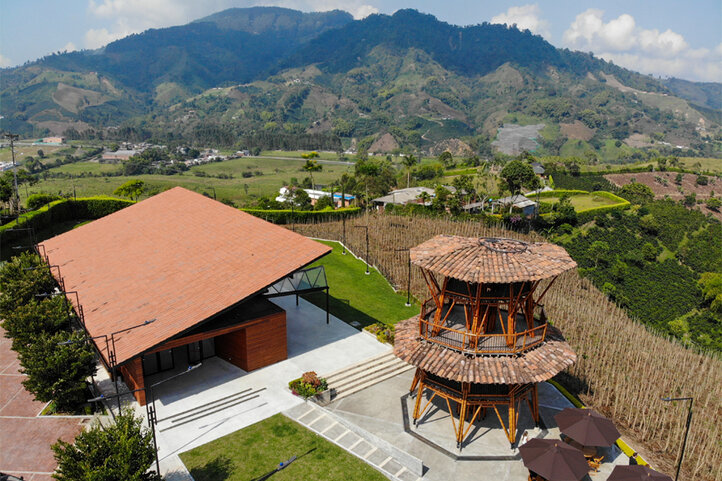
The building was designed by architect Simón Vélez using bamboo, wood and macana.
Gold Museum of the Banco de la Republica of Pereira
Carrera 9 # 18b-05
If you decide to visit this place, you can admire a great variety of gold and silver work from indigenous cultures of the pre-Columbian era.
Monument El Vigilante
Carrera 12 # 3-30
The artwork by Leonidas Mendéz depicts an elderly man with his hands clasped on his legs and his head bowed.
The artist wanted the sculpture to reflect the exhaustion associated with police work.
Sights near Pereira
Below are some places of interest near Pereira.
Marsella Botanical Garden
The botanical garden of the Municipality of Marsella offers a wide variety of fauna and flora, as well as a beautiful ecological path.
This place is 45 minutes’ drive from Pereira.
Otún-Quimbaya Wildlife and Flora Conservation Area
The Otún Quimbaya Wildlife Sanctuary is 15 km (9.3 miles) east of Pereira.
In this nature reserve you can see a wide variety of butterflies and birds.
In addition, you can hike here while admiring various hidden waterfalls.
Santa Rosa de Cabal Hot Springs
The Santa Rosa de Cabal hot springs are just an hour’s drive from Pereira.
Here you can bathe in the hot springs, but also enjoy a spa, ecological hiking trails and other activities such as waterfall abseiling.
The town also has a hotel and a restaurant.
Alto del Nudo Regional Natural Park
The Alto del Nudo Regional Natural Park is just 14 km (8.6 miles) from Pereira.
Inaugurated in 1992, the park is at an altitude of more than 1,800 meters above sea level and offers large green areas where you can see birds, anteaters and ocelots, among others.
Recreation Park Comfamiliar Galicia
The Comfamiliar Galicia Amusement Park is located at km 11 of the Vía Cerritos, Pereira – Galicia sector.
This leisure and holiday center has several areas, including various sports fields, fishing lakes and swimming pools.
Archaeological Museum Eliseo Bolivar
The Eliseo Bolivar Archaeological Museum is located 70 km (43.5 miles) from Pereira, more precisely in Belen de Umbria.
The museum has an extensive collection of more than a thousand pre-Columbian potsherds, most of which are local.
Tatamá National Park
Tatamá National Park is 56 km (34.7 miles) from Pereira.
The 51,900-hectare park is a sanctuary for numerous plant and animal species.
Ukumari Biopark
The Ukumarí Biopark is located at kilometer 14 of the Pereira – Cerritos road.
Covering an area of more than 800,000 square meters, you can see a variety of animals such as snakes, giraffes, lions, bears, elephants, rhinos and more.
Biopark Ukumarí also offers various fourth-dimensional attractions and simulators.
La Granja de Noé Ecopark
The Ecopark La Granja de Noé is located in the Parque Recreacional Comfamiliar Galicia at km 11 of the Vía Cerritos, Pereira – Sector Galicia.
Here you can interact with many animals and also enjoy large green areas.
San Vicente Hot Springs
The Termales de San Vicente are located 35 km (21.7 miles) from the city of Pereira.
Here you will find 5 pools where you can swim to relax your body and mind.
In addition, you can see more than 160 species of birds in this beautiful place.
Belen de Umbria
Belén de Umbría is a municipality located 70 km (43.4 miles) from Pereira.
The community is known for its adventure tourism, with opportunities for paragliding and hiking.
Barbas-Bremen Regional Nature Park
The Barbas-Bremen Regional Nature Park is located in the municipality of Filandia, 32 km (19.8 miles) from Pereira.
If you like being in contact with nature, you should definitely visit this park, because here you can see a great variety of birds, howler monkeys, deer, cusumbos, guans and spectacled bears.
Calle Real de la Arepa
Calle Real de la Arepa is at km 11 of the Pereira – Cerritos road.
This street is known for enjoying the traditional food of Pereira as there are a variety of restaurants where you can try it.
Cocora Valley
The Cocora Valley is 46 km (28.5 miles) from Pereira, very close to the municipality of Salento.
Here are the famous giant wax palms and of course incredible views of the surrounding mountains.
If you decide to visit, you can go horseback riding or hiking.
Coffee Park
Parque del Café is located in the Municipality of Montenegro, 54 km (33.5 miles) from Pereira.
This theme park offers a variety of activities, including roller coasters, water rides, and various shows themed around coffee and local traditions.
Best time to visit Pereira
The best time to visit Pereira is between June and September when the weather conditions are more favorable for visiting the various tourist attractions in the city.
Also, in August you can enjoy the city’s most important event, Las Fiestas de la Cosecha.
Events in Pereira
Here are the main events that take place in Pereira throughout the year that you absolutely cannot miss.
Thanksgiving
Thanksgiving is celebrated every August to mark the city’s anniversary and promote coffee culture.
Various events take place during this month, e.g. B. the national Trova festival, the national orchid exhibition, vintage car parades, beauty contests, folk festivals, equestrian tournaments, folklore parades, horse exhibitions, craft fairs and various exhibitions of traditional dances.
In addition, various sports championships are held.
International Poetry Festival
The International Poetry Festival is an event organized by the Luna de Locos society with the aim of promoting and supporting artistic manifestations in the fields of cinema, literature, plastic arts, etc.
This festival, which has been taking place since 2007, is attended by national and international guests who hold readings in schools and public spaces.
The International Poetry Festival usually takes place between August and September.
National Bambuco Competition
The National Bambuco Competition brings together the best of Bambuco authors and composers so that they can inspire the people of Pereira with their talent.
Such is the importance of this competition that on June 20, 2005 it was declared a national heritage site.
International Eye Rock Festival
The international festival Eje Rock, usually held in August, is an event that brings together national and international rock bands.
The importance of this festival is such that in 2016 the Pereira City Council declared it an event of cultural interest for the city.
Expocamello
Expocamello is an event that brings together more than 300 entrepreneurs to exchange ideas with the country’s most important entrepreneurs in order to boost their business.
In addition, the 5 best ventures will receive a financial prize.
This event usually takes place in August.
Nightlife in Pereira
Pereira has some incredible places to enjoy music and dancing, here are some of them.
Las Primaveras de Yuri Pereira
Avenida Circunvalar # 12-50
https://www.facebook.com/lasprimaverasdeyuripereira/
At Las Primaveras de Yuri Pereira you can enjoy various events and shows where you can sing, drink and dance.
Lion Reggae Bar
Calle 22 #12-32
https://www.facebook.com/ONELOVEREGGAEBAR/
The best place in Pereira to enjoy reggae music.
La Obra Show Bar Pereira
Arboleda Park Shopping Center
https://www.facebook.com/laobrashowbarpereira/
La Obra Show Bar Pereira is known for its warm atmosphere and attentive staff.
Here you will find alcoholic and non-alcoholic beverages to accompany your meetings with friends and family.
Typical dishes in Pereira
Here are some of the typical dishes that you can find in the city of Pereira.
Solteritas
Solteritas are fried wheat flour biscuits containing cream with orange extract.
Bandeja Paisa
Bandeja Paisa is a dish made with beans, fried or minced meat, beans, chicharrón, lettuce, rice, chorizo, ripe plantains, arepa, avocado, and egg.
Sudado
Sudado is a dish made with beef, chicken or pork, yucca, plantains, potatoes and lettuce.
Mondongo
Mondongo is a dish made with pork, tripe and various vegetables.
This dish is usually served with avocado, mazamorra, arepa and rice.
Morcilla (blood sausage)
Morcilla is a rice sausage mixed with pig’s blood and bits of bacon.
Rice with vegetables
Arroz con legumbres is a dish that includes lentils, chickpeas, fried three or chicken, peas and, of course, rice.
Stuffed Potato
The Papa Rellena contains eggs, chicken, meat and cheese.
Sancocho
Sancocho is a broth made from ribs, chicken meat to which yucca, potato, corn on the cob and pieces of plantain are added.
Rice with milk and coconut
A dish essentially consisting of rice, milk and coconut.
Accommodation in Pereira
Here are some of the accommodation options in Pereira, Colombia:
Sonesta Hotel Pereira
Km 7 on the Pereira-Cartago road
CLICK HERE TO GET THE BEST RATES FOR SONESTA HOTEL PEREIRA
Sonesta Hotel Pereira features convenient facilities such as an outdoor pool, convention center, restaurant, gym and tennis court.
The rooms are equipped with air conditioning, cable TV, minibar, hair dryer and private bathroom.
Sonesta Hotel Pereira is 13 km (8 miles) from Matecaña International Airport, 10 km (6.2 miles) from Expofuturo Convention Center and 11 km (6.8 miles) from Hernan Ramirez Villegas Stadium and the Pereira Olympic Village.
Movich Hotel de Pereira
Carrera 13 # 15-73
CLICK HERE TO GET THE BEST RATES FOR THE MOVICH HOTEL DE PEREIRA
The Movich Hotel de Pereira offers its guests very pleasant facilities such as an outdoor pool, gym, spa and 3 restaurants.
The rooms are equipped with flat screen TV, air conditioning, private bathroom and minibar.
Movich Hotel de Pereira is just 3 km (1.8 miles) from Matecaña International Airport and 5 minutes’ walk from the city centre.
Hotel Soratama
Carrera 7 # 19-20
CLICK HERE TO GET BEST RATES FOR HOTEL SORATAMA
Hotel Soratama is located in the heart of the city center and has a bar, a restaurant serving local dishes and a beautiful terrace from which you can enjoy a wonderful view of the city.
The rooms are equipped with a private bathroom, air conditioning, cable TV and a minibar.
Hotel Soratama is 45 minutes’ drive from Santa Rosa’s thermal baths and just 10 minutes’ drive from Matecaña International Airport.
How to get to Pereira
The city of Pereira is 325 kilometers from Bogotá, the capital of Colombia. There are several ways to get from Bogotá to Pereira.
Airplane
The quickest way to get to Pereira is by plane. Matecaña International Airport is connected to Bogotá and the main cities in the country. This airport is located at kilometer 4 of the road to Cerritos.
You can fly with different airlines like Avianca or Latam.
Bus
Pereira has a bus station at Calle 17 No. 23 – 157, from where you can travel with buses from companies such as Velotax, Flota Magdalena, Bolivariano and Expreso Palmira.
The drive from Bogota takes about 8 hours.
The easiest way to buy tickets is via Pinbus.
By car
Another option is to travel by car, although it can be quite long, taking between 8 and 9 hours depending on traffic jams and speed.
Please note that you have to pay around 6 tolls on the route.
The following companies rent cars in Colombia:
- Hertz
- Avis
- ABC
Colombia Travel Guides
Here you will find travel guides for the most popular regions in Colombia, which we have put together during our extensive travels around the country.
- Colombia Travel Guide
- Bogota Colombia Travel Guide
- Medellin Colombia Travel Guide
- Cartagena Colombia Travel Guide
- Santa Marta Colombia Travel Guide
- Cali Colombia Travel Guide
- Coffee Triangle Colombia Travel Guide
- Barranquilla Colombia Travel Guide
- La Guajira Colombia Travel Guide
- Tayrona Park Colombia Travel Guide
- Palomino Colombia Travel Guide
- San Andres Island Colombia Travel Guide
- Providencia Island Colombia Travel Guide
- Casanare Llanos Colombia Travel Guide
- Amazonas Colombia Travel Guide
- Chocó Colombia Travel Guide
- Santander Colombia Travel Guide
- Boyaca Colombia Travel Guide
Travel Guides to Colombia’s Small Towns
Here you will find travel guides for less popular destinations in Colombia. Some of these destinations are even real insider tips and not even known to the Colombians as travel destinations.
- Aguachica Colombia Travel Guide
- Arauca Colombia Travel Guide
- Armenia Colombia Travel Guide
- Barrancabermeja Colombia Travel Guide
- Bucaramanga Colombia Travel Guide
- Buenaventura Colombia Travel Guide
- Canyon Chicamocha Colombia Travel Guide
- El Carmen de Bolivar Colombia Travel Guide
- Caucasia Colombia Travel Guide
- Cucuta Colombia Travel Guide
- Florencia Colombia Travel Guide
- Ibagué Colombia travel guide
- Inirida Colombia Travel Guide
- Ipiales Colombia Travel Guide
- Magangue Colombia Travel Guide
- Manizales Colombia Travel Guide
- Mitu Colombia Travel Guide
- Mocoa Colombia Travel Guide
- Monteria Colombia Travel Guide
- Neiva Colombia Travel Guide
- Palomino Colombia Travel Guide
- Palmira Colombia Travel Guide
- Pasto Colombia Travel Guide
- Pereira Colombia Travel Guide
- Popayan Colombia Travel Guide
- Puerto Asis Colombia Travel Guide
- Puerto Carreno Colombia Travel Guide
- Quibdo Colombia Travel Guide
- Riohacha Colombia Travel Guide
- San José del Guaviare Colombia Travel Guide
- Sincelejo Colombia Travel Guide
- Sogamoso Colombia Travel Guide
- Tayrona Park Colombia Travel Guide
- Tulua Colombia Travel Guide
- Tumaco Colombia Travel Guide
- Tunja Colombia Travel Guide
- Turbo Colombia Travel Guide
- Valledupar Colombia Travel Guide
- Villa de Leyva Colombia Travel Guide
- Villavicencio Colombia Travel Guide
- Yopal Colombia Travel Guide
