
Updated on 04/02/2024
Dear readers
My name is Frank and I run a tour operator in Bogota, specializing in custom-made and Colombia luxury travel.
At the end of this guide you will find a list of many other helpful travel guides for Colombia.
Content
Introduction
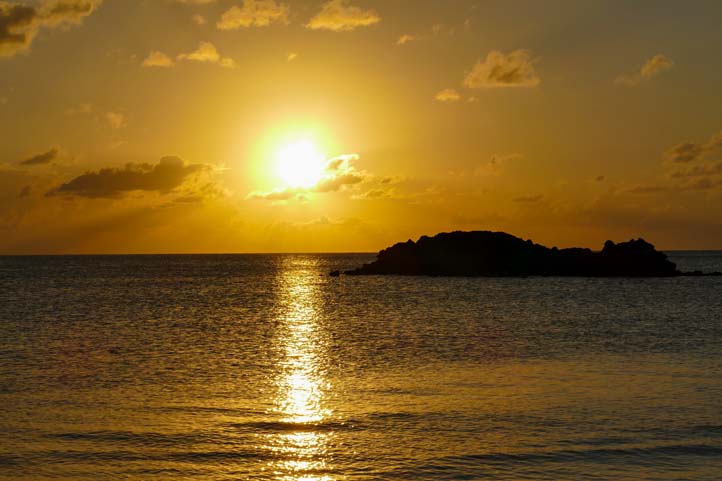
I traveled to  Providencia in 2015 and 2018, but I think nothing has changed in the meantime. The island is a Caribbean dream, as you would imagine or have seen in advertisements. Once arrived on the island, one is mesmerized by the different shades of blue of the water. Some speak also of the 7 blue tones, which one sees in the water around the island.
Interestingly, Providencia is far away from Colombia, at the height of Nicaragua. There are therefore always discussions between the two countries. It has a history of being an island where pirates and privateers docked during colonial times. The most renowned is Henry Morgan.
In general, the infrastructure in Providencia is sufficient but there is a lack of investment everywhere, and it is noticeable. This has to do with the fact that the island has committed itself to a protectionist policy. Who knows San Andres, the neighboring island, knows why. It’s about protecting the local culture and the locals.
Accordingly, outsiders cannot invest without losing control of capital. Therefore, how much capital still flows to the island, everyone can calculate. A good example is the airport. This was recently expanded for an insane amount to offer international flight routes in the future.
The residents of Providencia have then decided that they do not want to increase the frequencies and prefer peace rather than more tourists. There is mobile phone signal available and even a little data. Also, various hotels and accommodations offer WIFI. Reliability and speed of connections, however, are so so.
It is pretty cozy on the island and visitors will find peace with a guarantee. The National Natural Park “Old Providence McBean Lagoon” is located on the northeast side of the island, and is famous for being a Seaflower Biosphere Reserve, perfect for diving.
By the way, there are 2 ways to reach the island. You can take a ferry from San Andres, which can take up to 5 hours depending on the waves. You can also fly over from San Andres in 15 minutes with a small plane.
There is an ATM at the pier.
The local population on Providencia speaks Creole. This sounds like English, but you do not understand a word. However, all residents speak perfect English and Spanish.
Here is a WARNING: Beware of falling coconuts – they can kill you!
Since Providencia belongs to Colombia, you should also read our Colombia travel guide.
Activities and attractions on Providencia
Tours
You can book various excursions in all accommodations, or you get the appropriate contact at least. The island is so small that all residents know each other personally. Above all, various boat tours cover most attractions.
Santa Isabel
The capital of the village offers various supermarkets and accommodation. The ferry from San Andres arrives here.
South West Beach
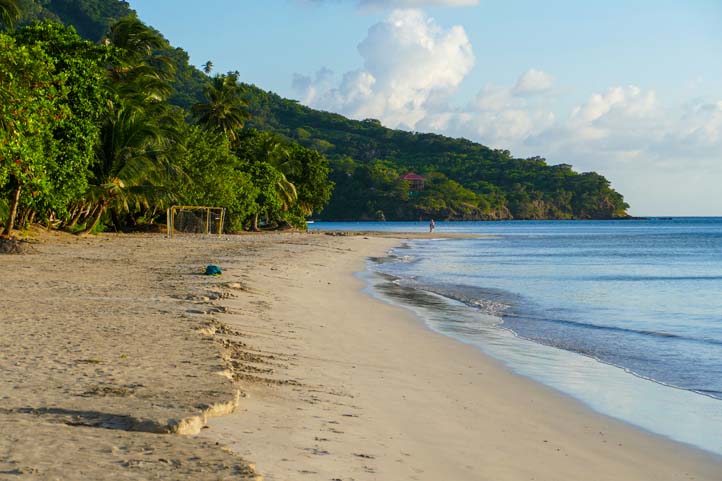
In my opinion, the best beach is, as the name implies, on the southwestern part of the island. The perfect beach offers fine Caribbean sand and a beautiful calm sea.
You can also eat the infamous seafood plate there. At that time it cost 40,000 pesos and was sufficient for two very hungry persons. On my first visit, I was the only visitor for 3 days on the beach.
Every Saturday a horse race takes place, with two riders competing against each other. The spectacle is very short and you have to be ready at the right time if you want to film it.
What I have also observed is that you can wakeboard pulled from a horse. However, one must certainly not exceed a maximum weight.
El Pico
You can book a tour or climb the highest point of the island by yourself. At the foot of the hill, I was offered a local guide for 30,000 pesos, which I took with me to the ascent. This is not necessary, but it supports the local inhabitants.
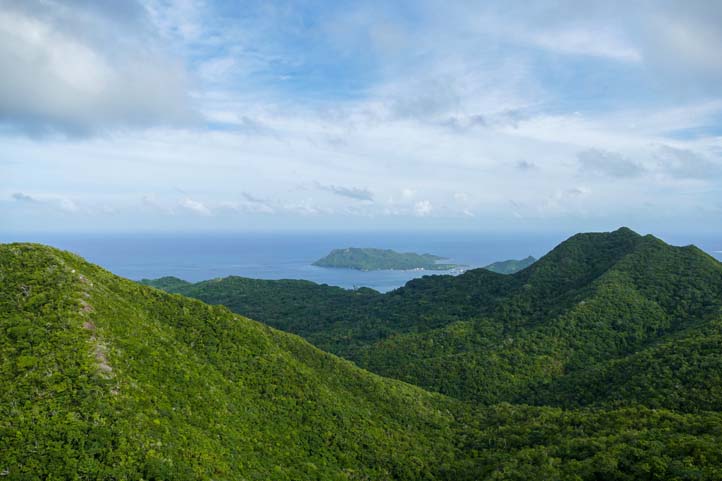
When I arrived at the top, I had to wait 10 minutes until he arrived as well. By the way, you will be rewarded with a 360° view on top. The different shades of blue in the sea can be seen and also exactly where the coral reef lies.
I recommend the climb early in the morning, as it can get hot during the day. The climb should be just under an hour, unless you take it very easy.
Cayo Cangrejo / Crab Caye
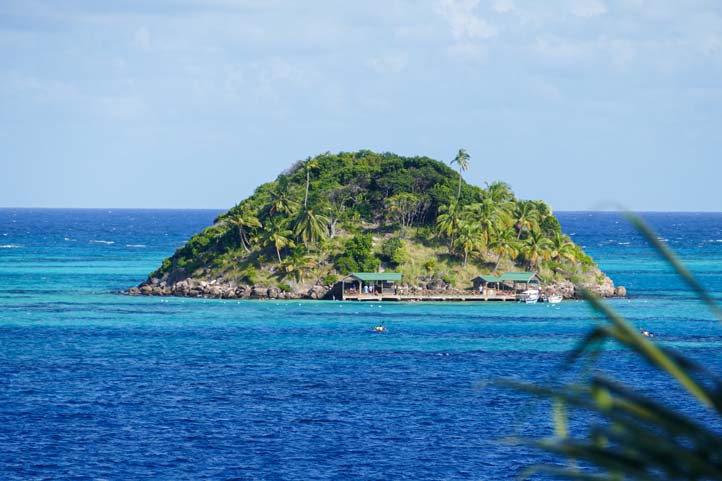
The easiest way to get there: Drive to the hotel Deep Blue and from there you will find several options. You can rent one of the canoes, swim or motorboat.
Arriving on Crab Caye, you have to pay a token to enter the island. You can then snorkel around this small island, swim, or climb the island and enjoy the beautiful view from above. This trip is definitely worth it.
Almond Bay
One of the many small beaches found on Providencia, just 10 minutes walk from the road.
Santa Catalina
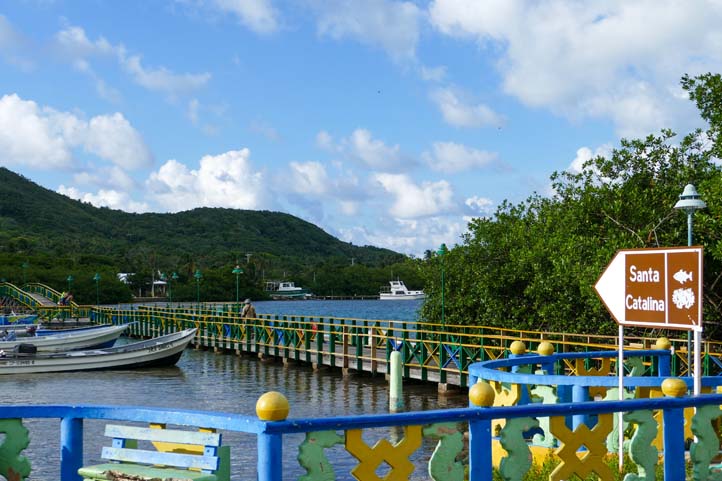
From Santa Isabel, you just have to cross the pretty wooden bridge and you are on the neighboring island of Santa Catalina. However, this is on foot, driving is not allowed.
Here you can either go left or right. To the right, you come to an old cannon and to the left you can walk past the houses of the inhabitants. But Morgan’s head, a rock formation that looks like a head, is better seen from a boat.
I’ve also been told that you can see many rays under the bridge at night, but I did not notice that spectacle.
Bahia Aguadulce / Fresh Water Bay
This is probably the most touristic beach in Providencia. Many restaurants and hotels are located in the area and many tours start from here.
Roland Roots Reggae Bar & Restaurant
Also located on a beach, there is played cozy reggae music in the evening and you can enjoy a cold beer. Striking that apparently, only male islanders visit this bar, sometimes in the company of lonely female tourists. It was surprising that the local men, in contrast to the average Colombian, have grown very large. I was partly the smallest and this with a stately size of 188 cm (6.2).
I would say this bar has a decidedly Jamaican feel.
Diving around Providencia
There are several diving schools in Providencia. The coral reef is protected and as far as I’ve heard, I’m not a diver myself, the underwater world is spectacular and divers come from all over the world. UNESCO also recognized the entire archipelago in 2000 as a biosphere reserve.
Horse riding
There are an amazing number of horses on Providencia for one such small island. So who wants to experience horseback riding, horseback riding on the beach and even riding in the water, asks the best locally.
Fishing
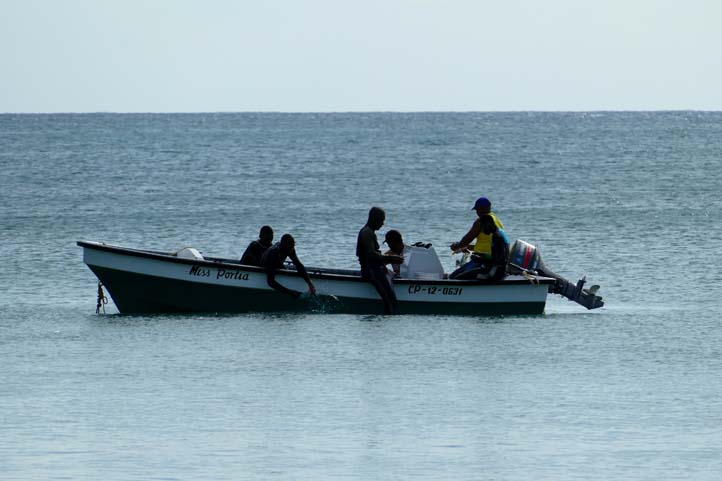
If you like fishing, hey it is an island! Local fishermen are more than happy to take you with them and then tell stories of pirates and sea monsters.
Recommended Accommodation on Providencia
As already explained, the island lacks investment. So there are not many accommodations that I can really recommend. Personally, I have always stayed with a family. In so-called Posadas, you get beds, rooms with air conditioning and breakfast for a reasonable price.
I can recommend the following hotels:
Hotel Deep Blue
This is by far the best hotel on the island. It has terraced rooms, some with their own small pools and a magnificent view of Cayo Cangrejo. The restaurant is virtually floating on the water.
Hotel Sirius
Located directly on Southwest Beach, this hotel has probably the best location on the island and also an attached diving school.
Cabañas Agua Dulce
This accommodation is not luxurious, but Agua Dulce is the perfect place because it is quiet, yet there are various restaurants and a beautiful beach.
Nightlife on Providencia
As far as I know, the nightlife is limited to Roland Roots Reggae Bar & Restaurant and Freshwater Bay, where you can sometimes find live bands or even celebrate parties.
Cultural Agenda of Providencia
A kind of festival is the time of the black crabs. Between April and June, the crabs march towards the sea to lay eggs. After 20 days, the offspring marches back from the sea to the forests of the island. You have to be careful on the streets, because they are full of creepy-crawlies and it may be that sometimes even driving bans are pronounced. At the same time, the military is also sending soldiers to guard the crabs with their rifles.
The carnival is celebrated around the 20th of June. Then, of course, a lot of music is played, everybody dances and there will be a little drinking too.
Shopping on Providencia
I am not aware of anything specific to Providencia and what it would be worth buying.
Food on Providencia
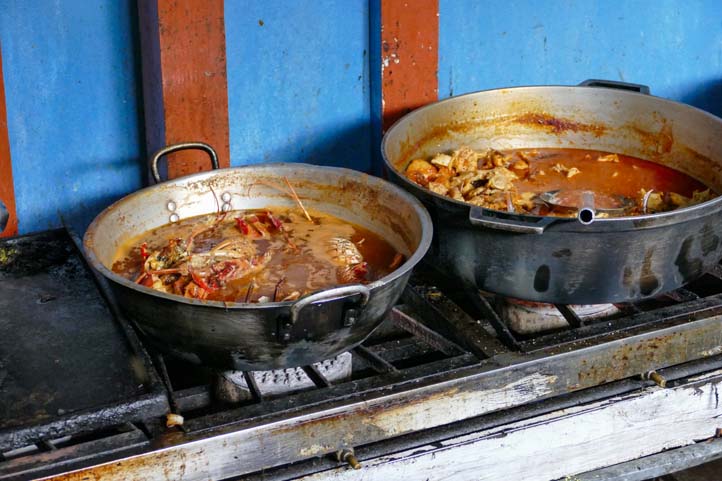
On Providencia, of course, the specialty is everything that comes from the sea. There are the black crabs, which are considered an absolute delicacy by the islanders. Then also sea snails are prepared, which are so tough in their original form, that they must be cooked for hours. As a finished dish, the sea snails are quite tasty.
The best restaurants in Providencia in my opinion are:
Deep blue restaurant
The restaurant belongs to the hotel of the same name. You eat, so to speak, on the water, on the weather side of the island. As a result, the temperature is perfect and mosquitoes will not bother you. The food is almost gourmet and the view with moonlight is just perfect and very romantic.
Divino Nino Jesus
This is probably the most famous restaurant on the island. Located on Southwest Beach, you get the legendary fish plates there. An absolute MUST DO, otherwise, you were not on Providencia.
Caribbean Place Donde Martin
Located on Freshwater Bay, this restaurant offers great food and live music or cultural events. This is also a restaurant where you should have eaten.
Cafe Studio
There, I ate my sea slugs and if you pass in the afternoon, then the processing is also explained. It is also one of the few places where you can drink a good coffee and enjoy good desserts.
There are many more places where you can eat well. It is best to ask the locals and then go with the scooter and try it out.
Best time to go to Providencia
Providencia is not overcrowded even during the high season, as the neighboring island of San Andres is much more popular with Colombians. Only in September and October, it can rain a lot and in connection with the hurricane season in the Caribbean, it can sometimes storm.
Colombia is not only our passion but also our business. As a travel agency in Bogota, Colombia, we specialize in bespoke travel across the country. Contact us for a personal consultation.
Airport of Providencia
The airport of Providencia, El Embrujo airport, has only one connection with San Andres. However, it should be possible to fly with private machines. Besides Satena, which flies twice a day, there are other providers. The flight time is about 15 minutes and you can arrive the same day from Bogota and Cartagena.
There is a weight limit for luggage, which is 10kg. However, for a small additional charge, you can take more luggage with you, unless the total weight exceeds the capacity of the small aircraft. There is also the possibility to deposit luggage at the airport.
Another detail is that you have to pay a fee for your trip to San Andres. This usually has to be paid in cash at the gate and is currently about COP 115,000.– per person.
Arrival by ferry from San Andres to Providencia
On my first trip to Providencia, I arrived by ferry, a motor catamaran. You have to be in San Andres Harbor two hours before departure. The locals, however, come only 30 minutes before departure.
You have to buy the ticket online. I cannot say if you can get it at a local counter. However, since the 3 existing ferries do not run every day, you should inform yourself in advance. In particular, the ticket should be purchased in advance, as the ferries can also be full and there might be no more tickets available.
Depending on the weather and waves, the journey takes up to 5 hours. The previously distributed drugs for nausea sometimes help or not. On my journey, about 70% of the passengers had to surrender. On the ride of a colleague a passenger even fainted and was picked up by the ambulance in Providencia on the pier.
The return trip is usually with and not against the waves. It is therefore faster and much more relaxed.
Buying tickets online, follow this LINK
Transport system on Providencia
There are two buses on Providencia, one in a clockwise direction, the other in a counterclockwise direction. The island is small, but the frequency is still very disappointing. Also sometimes those buses are not in service.
When you arrive at the airport, there are taxis waiting to take you anywhere on the island and you can order the taxis anywhere.
The easiest way to get around the island is to rent a scooter or a golf cart. However, you should drive carefully, as the local youth is crazy and run their motorcycles fast and even without lights at night.
What I like about Providencia and what I do not like
Providencia is a dream island. There’s nothing I do not like about the island.
Colombia Travel Guides
Here you will find travel guides for the most popular regions in Colombia, which we have put together during our extensive travels around the country.
- Colombia Travel Guide
- Bogota Colombia Travel Guide
- Medellin Colombia Travel Guide
- Cartagena Colombia Travel Guide
- Santa Marta Colombia Travel Guide
- Cali Colombia Travel Guide
- Coffee Triangle Colombia Travel Guide
- Barranquilla Colombia Travel Guide
- La Guajira Colombia Travel Guide
- Tayrona Park Colombia Travel Guide
- Palomino Colombia Travel Guide
- San Andres Island Colombia Travel Guide
- Providencia Island Colombia Travel Guide
- Casanare Llanos Colombia Travel Guide
- Amazonas Colombia Travel Guide
- Chocó Colombia Travel Guide
- Santander Colombia Travel Guide
- Boyaca Colombia Travel Guide
Travel Guides to Colombia’s Small Towns
Here you will find travel guides for less popular destinations in Colombia. Some of these destinations are even real insider tips and not even known to the Colombians as travel destinations.
- Aguachica Colombia Travel Guide
- Arauca Colombia Travel Guide
- Armenia Colombia Travel Guide
- Barrancabermeja Colombia Travel Guide
- Bucaramanga Colombia Travel Guide
- Buenaventura Colombia Travel Guide
- Canyon Chicamocha Colombia Travel Guide
- El Carmen de Bolivar Colombia Travel Guide
- Caucasia Colombia Travel Guide
- Cucuta Colombia Travel Guide
- Florencia Colombia Travel Guide
- Ibagué Colombia Travel Guide
- Inirida Colombia Travel Guide
- Ipiales Colombia Travel Guide
- Magangue Colombia Travel Guide
- Manizales Colombia Travel Guide
- Mitu Colombia Travel Guide
- Mocoa Colombia Travel Guide
- Monteria Colombia Travel Guide
- Neiva Colombia Travel Guide
- Palmira Colombia Travel Guide
- Pasto Colombia Travel Guide
- Pereira Colombia Travel Guide
- Popayan Colombia Travel Guide
- Puerto Asis Colombia Travel Guide
- Puerto Carreno Colombia Travel Guide
- Quibdo Colombia Travel Guide
- Riohacha Colombia Travel Guide
- San José del Guaviare Colombia Travel Guide
- Sincelejo Colombia Travel Guide
- Sogamoso Colombia Travel Guide
- Tulua Colombia Travel Guide
- Tumaco Colombia Travel Guide
- Tunja Colombia Travel Guide
- Turbo Colombia Travel Guide
- Valledupar Colombia Travel Guide
- Villa de Leyva Colombia Travel Guide
- Villavicencio Colombia Travel Guide
- Yopal Colombia Travel Guide
