
Updated on 03/15/2024
Dear readers
My name is Frank and I run a tour operator in Bogota, specializing in custom-made and Colombia luxury travel.
At the end of this guide you will find a list of many other helpful travel guides for Colombia.
Content
Why visit Ipiales?
The city of Ipiales, popularly known as the “City of Green Clouds” for its multicolored clouds and its sunsets, is one of the cities of the Nariño department and is located on the border with Ecuador.
The city borders to the east with the municipality of Puerres, to the south with Ecuador, to the north with the municipalities of Pupiales and Gualmatán, and to the west with the municipality of Aldana.
Ipiales is an excellent tourist destination as it is surrounded by nature and has many historical places to visit with great architecture.
In addition, Ipiales has a wide gastronomic offer, so you can delight your taste buds with dishes such as the “cuy asado” (roasted guinea pig).
Facts about Ipiales
- Ipiales is considered Colombia’s second most important land port, which is due to the trade exchange with Ecuador.
- Ipiales is also known as “The City of the Three Volcanoes” as you can see the Chilean, Azufral and Cumbal volcanoes from any part of the city.
- Ipiales is at an altitude of 2,900 meters above sea level.
- Ipiales is located in the southeast of the department of Nariño.
- Ipiales has a temperate climate with temperatures between 8°C and 22°C.
- The season when Ipiales receives more tourists is Holy Week, celebrated in the months of March and April.
- The main economic sectors in Ipiales are trade, agriculture, animal husbandry and tourism.
- Ipiales has a population of about 170,000 inhabitants.
- Ipiales consists of 148 neighborhoods.
- Ipiales was founded on September 7, 1810.
- Ipiales has an area of 1,707 square kilometers.
Tourist attractions in Ipiales
Below we present some of the most important sights of the city:
Plaza 20 de Julio
Plaza 20 de Julio, formerly known as Plaza Mayor, is in the center of the city.
This modern style park was the first park in the history of Ipiales.
The Plaza 20 de Julio is surrounded by the Cathedral of San Pedro and the City Palace.
San Pedro Cathedral
The Cathedral of San Pedro, also known as the Cathedral of Ipiales, is located in the center of the city, next to Plaza 20 de Julio.
This cathedral was built in the middle of the XIX. Built in the late 19th century, 1869 to be precise, it has a republican style and has beautiful religious artworks inside.
Cultural Center of the Banco de la Republica
The Banco de la República Cultural Center has a collection of more than 200 objects symbolic of the Quillasinga and Los Pastos cultures. It also regularly hosts exhibitions, conferences and workshops on various themes, particularly those of the indigenous people of southern Nariño.
Santander Park
Santander Park is in the center of the city, opposite the Army Battalion.
The park has large green spaces and is a meeting place for cultural marches and religious processions.
El Charco
El Charco is a traditional neighborhood of Ipiales, located on the way to Las Lajas Sanctuary.
In this place, pre-Hispanic drawings by the well-known artist Carlos Santacruz are painted on the facades of the houses.
There is also a wide range of restaurants in this district where you can enjoy the authentic dishes of the region.
Carrera Sexta
Carrera Sexta, also known as Calle Real, is 0.8 km (0.5 miles) long and connects Parque Santander with Plaza 20 de Julio.
Along this street corridor you will find various supermarkets, banks, government institutions and trading companies.
Avenida Mistares
Avenida Mistares is the ideal place to have fun and relax as it is surrounded by a wide variety of bars and restaurants.
Ipiales Marketplace
The marketplace of Ipiales is on Carrera 4 # 1-1, a very colorful place where you can find different foods that are produced in Ipiales and some others that come from different municipalities of the Nariño department.
Recreation Park Ipiales 2000
The Ipiales 2000 amusement park is located on the road leading to San Luis Airport.
This park has children’s playgrounds, a semi-Olympic indoor pool, and various courts for micro-football, basketball, and beach volleyball.
Things to see near Ipiales
Here are some interesting places near Ipiales.
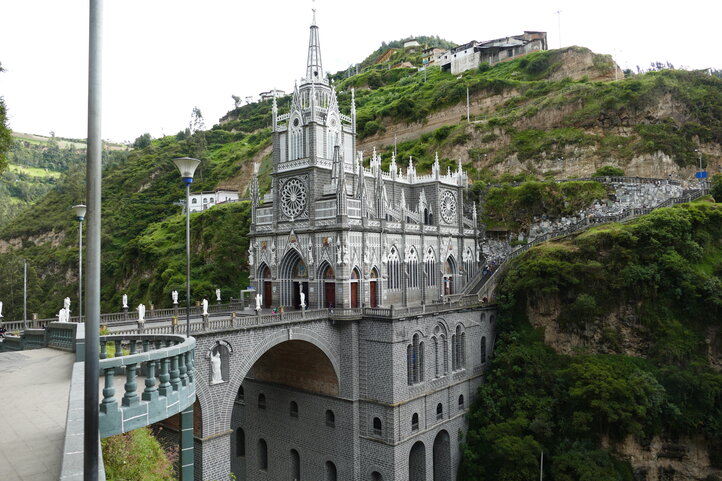
Sanctuary of Nuestra Señora del Rosario de Las Lajas
The Sanctuary of Nuestra Señora del Rosario de las Lajas is located 7 km (4.3 miles) from Ipiales and is visited by thousands of tourists and pilgrims from different countries.
Completed on August 20, 1949, the Gothic-style basilica stands on the precipice of the Guáitara River, surrounded by a beautiful natural landscape.
The Santuario de las Lajas is considered the most spectacular church in Colombia due to its architectural design.
Volcano Cumbal
Cumbal Volcano is located in the municipality of Cumbal, 30 km (18.6 miles) from Ipiales.
This 4,764-meter-high volcano is majestic and very well visited by tourists who take around 4 hours to reach the top.
Green Lagoon
Laguna Verde is located 56 km (34.7 miles) from Ipiales, very close to the municipality of Túquerres.
This beautiful place is located in the crater of the Azufral volcano, which is at an altitude of over 3,600 meters above sea level.
The Laguna Verde is so impressive that it is considered one of the seven natural wonders of the world.
Museum of Las Lajas
The Las Lajas Museum is located in one of the caves of the Sanctuary of Nuestra Señora del Rosario Las Lajas.
Here you will find various religious pieces, ceramic works and paintings about the region’s indigenous culture.
International Bridge of Rumichaca
The Rumichaca International Bridge crosses the Guaitara River, also known as the Carchi.
The bridge was inaugurated in 1972 and is of great importance for trade and tourism as it is on the Colombian-Ecuadorian border.
The International Bridge of Rumichaca is just 3 km (1.8 miles) from the city of Ipiales.
The Monkey Stones
The Monkey Stones are located a few meters from the Las Lajas Sanctuary.
These stones are famous because they were sacred to the region’s indigenous communities.
Binational House of Culture
The Binational House of Culture is located at the Rumichaca International Bridge, where photographs, manuscripts and other objects related to Juan Montalvo and his important milestones in Ipiales are exhibited.
Best time to visit Ipiales
The best time to visit Ipiales is between March and May, when the weather conditions are more favorable to visit and enjoy the city’s various tourist attractions.
Events in Ipiales
Here are the main events that take place in Ipiales throughout the year that you absolutely cannot miss.
Feast of the Virgen de Las Lajas
The Fiesta de la Virgen de Las Lajas is a celebration of Our Lady of Las Lajas.
Thousands of pilgrims from Colombia and other countries take part in this festival, which takes place every year on September 16th.
Ipiales Cine sin Fronteras Film Festival
The Festival Ipiales Cine sin Fronteras is an event dedicated to the promotion of new filmmakers and producers.
During this festival, which has been held since 2016, open-air film screenings and various conferences promoting film culture are held.
The Festival Ipiales Cine Sin Fronteras takes place every June, directed by Edison Alberto Romero Romero, Yesid Baraona and Nereida Figueroa.
Multicolor carnival on the border
The Carnaval Multicolor de la Frontera, also known as the Carnaval de Ipiales since 1930, is the local version of the Carnaval de Negros y Blancos.
During this festival there are various processions, artistic performances and musical performances.
The carnival takes place every year in the first days of January.
Birthday of Ipiales
The founding of the city is celebrated on September 7th of each year. Various commemorative events such as art exhibitions and musical performances are held on this day.
International Festival Ipiales Cuna de Grandes Trios (Ipiales – Cradle of the Great Trios)
The International Festival Ipiales Cuna de Grandes Trios is an event that brings together the best national and international exponents of trio music.
This event takes place every year in October.
Such is the importance of this festival that in 2018 it was declared a national heritage site by the Congress of the Republic.
Nightlife in Ipiales
Ipiales has some incredible places to enjoy music and dance, here are some of them.
El Tertuliadero Rock Bar
Carrera 26 # 22-95
https://www.facebook.com/profile.php?id=100054539405638
The Tertuliadero Rock Bar is known for its warm atmosphere and attentive staff.
Here you will find alcoholic and non-alcoholic beverages to accompany your meetings with friends and family.
Bourbon Ipiales
Mistares 2 Etapa Casa 217
https://www.facebook.com/bourbonipiales/
If you like reggaeton, you must visit Bourbon Ipiales.
Barbacana
Panam district
https://www.facebook.com/profile.php?id=100071158908650
There is a wide range of music and cocktails at the Barbacana.
Typical food in Ipiales
These are some of the typical dishes that you can find in the town of Ipiales.
Sopa de arrancadas
Sopa de arrancadas is a broth made with potatoes, onions and cabbage to which small pieces of wheat flour are added.
Camchape
Camchape is basically ground, roasted corn mixed with panela and milk.
Fried Cuy
Cuy asado is a dish made with guinea pig, garlic, salt and cumin.
Barley soup
Sopa de cebada is a soup made with guata potatoes, long onions and thorn bones.
Colada de aco
Colada de aco is a drink that contains milk and cinnamon.
Llapingachos
Llapingachos are potato tortillas fried with lard and some cheese.
This dish is usually served with pork and a mixed salad of lettuce and sliced tomatoes.
Locro soup
Sopa de locro is a dish that includes cabbage, broad beans, ocas, yellow potatoes, ullocos, green beans, potato guata, spinach, and green peas.
Flatbread on Cayana
Arepas en Cayana are made with wheat flour, lard, water, baking powder, salt and sugar or panela.
Honey donut
Buñuelos de Miel are made from wheat flour, egg, powdered cinnamon, lemon peel and honey.
Quimbolitos
Quimbolitos are a pastry made from cornmeal, egg, butter, cheese and sultanas.
Cornsup
Sopa de maíz is made with cabbage, corn, arracacha, beans and cabbage.
This dish can also contain beef, pork, veal or mutton.
Fritada Ipialeña
Fritada Ipialeña is a dish made with potatoes, pork and crispetas.
Empanadas de anejo
Empanadas de añejo are made with fermented corn dough and filled with a stew of peas, rice, and meat.
Hornado
El hornado is basically baked pork served with corn, lettuce, and boiled potatoes.
M olo
Molo is mashed potatoes with salt, lard, onions and coriander.
Champus
Champús is a drink made from corn, honey, and fruits such as pineapple and lulo, flavored with cloves or cinnamon.
Accommodation in Ipiales
After a day exploring the wonders of Ipiales, what better than resting in a comfortable and cozy hotel? Discover our recommendations of the Best Hotels in Ipiales, Nariño in the most charming neighborhoods of the city, where hospitality awaits you with open arms.
How to get to Ipiales
The city of Ipiales is located 842 kilometers from Bogotá, the capital of Colombia. There are several ways to reach Ipiales from Bogotá.
Airplane
The quickest way to get to Ipiales is by plane. San Luis Airport is connected to Bogotá. This airport is located 7 km (4.3 miles) from Ipiales.
You can fly with different airlines like Avianca or Satena.
The airlines that offer connections are as follows:
Bus
Ipiales has a bus station in the La Laguna neighborhood, more precisely on Carrera 2 # 2-81. You can travel with buses from companies such as Cootranar, Continental Bus, Bolivariano and Velotax.
The drive from Bogota takes about 19 hours.
The easiest way to buy tickets is via Pinbus.
By car
Another option is to travel by car, although it can be quite long, taking between 19 and 20 hours depending on traffic jams and speed.
Please note that you have to pay about 14 tolls on the route.
The following companies rent cars in Colombia:
- Hertz
- Avis
- ABC
Colombia Travel Guides
Here you will find travel guides for the most popular regions in Colombia, which we have put together during our extensive travels around the country.
- Colombia Travel Guide
- Bogota Colombia Travel Guide
- Medellin Colombia Travel Guide
- Cartagena Colombia Travel Guide
- Santa Marta Colombia Travel Guide
- Cali Colombia Travel Guide
- Coffee Triangle Colombia Travel Guide
- Barranquilla Colombia Travel Guide
- La Guajira Colombia Travel Guide
- Tayrona Park Colombia Travel Guide
- Palomino Colombia Travel Guide
- San Andres Island Colombia Travel Guide
- Providencia Island Colombia Travel Guide
- Casanare Llanos Colombia Travel Guide
- Amazonas Colombia Travel Guide
- Chocó Colombia Travel Guide
- Santander Colombia Travel Guide
- Boyaca Colombia Travel Guide
Travel Guides to Colombia’s Small Towns
Here you will find travel guides for less popular destinations in Colombia. Some of these destinations are even real insider tips and not even known to the Colombians as travel destinations.
- Aguachica Colombia Travel Guide
- Arauca Colombia Travel Guide
- Armenia Colombia Travel Guide
- Barrancabermeja Colombia Travel Guide
- Bucaramanga Colombia Travel Guide
- Buenaventura Colombia Travel Guide
- Canyon Chicamocha Colombia Travel Guide
- El Carmen de Bolivar Colombia Travel Guide
- Caucasia Colombia Travel Guide
- Cucuta Colombia Travel Guide
- Florencia Colombia Travel Guide
- Ibagué Colombia Travel Guide
- Inirida Colombia Travel Guide
- Ipiales Colombia Travel Guide
- Magangue Colombia Travel Guide
- Manizales Colombia Travel Guide
- Mitu Colombia Travel Guide
- Mocoa Colombia Travel Guide
- Monteria Colombia Travel Guide
- Neiva Colombia Travel Guide
- Palmira Colombia Travel Guide
- Pasto Colombia Travel Guide
- Pereira Colombia Travel Guide
- Popayan Colombia Travel Guide
- Puerto Asis Colombia Travel Guide
- Puerto Carreno Colombia Travel Guide
- Quibdo Colombia Travel Guide
- Riohacha Colombia Travel Guide
- San José del Guaviare Colombia Travel Guide
- Sincelejo Colombia Travel Guide
- Sogamoso Colombia Travel Guide
- Tulua Colombia Travel Guide
- Tumaco Colombia Travel Guide
- Tunja Colombia Travel Guide
- Turbo Colombia Travel Guide
- Valledupar Colombia Travel Guide
- Villa de Leyva Colombia Travel Guide
- Villavicencio Colombia Travel Guide
- Yopal Colombia Travel Guide
