
Updated on 03/12/2024
Dear readers
My name is Frank and I run a tour operator in Bogota, specializing in custom-made and Colombia luxury travel.
At the end of this guide you will find a list of many other helpful travel guides for Colombia.
Content
Why visit Neiva?
The city of Neiva, popularly referred to as the “Capital of the Magdalena River”, is the capital of the Department of Huila and is located in the Upper Magdalena Valley between the Ceibas River and the Loro River.
The city borders to the east with the municipality of Tello, to the south with the municipality of Rivera, to the north with the municipality of Aipe and to the west with the municipality of Palermo.
Neiva is a worthwhile tourist destination because it offers a wide variety of places rich in nature and history, as well as a rich gastronomy recognized nationally and internationally.
Facts about Neiva
- Neiva is at an altitude of 442 meters above sea level.
- Neiva has a warm climate with temperatures between 21° C and 35° C.
- The main industries in Neiva are agriculture and animal husbandry.
- Neiva is the most important city in southwestern Colombia.
- Neiva has 177 districts divided into 10 municipalities.
- The main shopping centers in Neiva are Santa Lucia Plaza and San Pedro Plaza Shopping Malls.
- Neiva has a population of approximately 370,000 inhabitants.
- Neiva is rich in gold, silver, oil, coal, salt, iron and copper.
- Bambuco is the most representative music genre in the city of Neiva.
- The Hymn of Neiva was composed by the Salesian priests Andrés Rosa Summa and Alfonso Arboleda Méndez.
- Neiva was founded on May 24th by Diego de Ospina y Medinilla.
- The Sanjuanero is the most representative folk dance of Huila. It is even a cultural heritage of Huila.
- Neiva has an area of 1553 square kilometers.
Tourist attractions in Neiva
Here are some of the city’s top attractions:
Malecon del Rio Magdalena
The Malecon del Rio Magdalena is one of the most visited places since here you can do various activities such as horseback riding, ecological walks, boat trips and the observation of different species of birds such as woodpeckers, herons, rosettes, blue tits, hummingbirds and cockatoos.
There is also a sports center, an area selling handicrafts such as paintings, weavings, hammocks, chairs and dresses, and finally a small square selling typical local food.
The Malecón del Río Magdalena runs from Avenida Circumvalar and Calle 10 to the mouth of the La Toma River at Calle 15.
La Gaitana Monument
The La Gaitana Monument is located on Avenida Circumvalar, on the banks of the Magdalena River, very close to the Paleontological Museum of Neiva.
This monument honoring the emblematic, freedom-loving indigenous warrior was erected in 1974 by the sculptor and teacher Rodrigo Arenas Betancourt.
The sculpture is made of bronze and is about 30 meters high.
National Post Office building
The National Post Office was built in 1934 in Arabic style.
This building now houses the offices of the National Postal Administration and the National Tax and Customs Administration (DIAN).
Spiritual Park La Sangre de Cristo
The Sangre de Cristo spiritual park is located at kilometer 13 of the Via Neiva – El Juncal.
In this park there are swimming pools, an artificial waterfall 50 meters high, extreme games and the largest crucified Christ in the world with a height of more than 60 meters.
Neiva Bertha Hernández de Ospina Botanical Garden
If you love nature, you cannot miss the Bertha Hernández de Ospina Botanical Garden in Neiva, located to the south of the city.
The botanical garden has an extension of 20 hectares and offers a great variety of fauna and flora, in particular the more than 100 species of birds that can be observed here.
Acoustic Shell Jorge Villamil
The Jorge Villamil Acoustic Shell is located in the Children’s Park.
Artistic and cultural events take place here throughout the year.
Archaeological Regional Museum of Neiva
The Regional Archaeological Museum of Neiva is located in the José Eustasio Rivera Convention Center.
It houses a large collection of gold and silverwork, petroglyphs, pottery, bone and stone artefacts found in and around the city of Neiva.
More than 300 pieces from different historical periods can be seen here.
Olympic Village
The Villa Olímpica is located at Calle 7 # 09-02.
This place has modern facilities for practicing various sports and was built for the 12th edition of the National Games.
Here you will also find the Coliseo Cubierto, the official venue of the national beauty pageant, and the Guillermo Plazas Alcid football stadium.
Cuarto Centenario Monument
The Cuarto Centenario Monument was designed by Fernando Suárez to celebrate the 400-year history of the city of Neiva and is located at Carrera 2 and Calle 8.
This monument consists of 8 iron figures representing the culture of Neiva’s working people.
Neiva railway station
Neiva train station is located in the El Altico district, more precisely on Calle 7 with Carrera 16, near the Andino Park and the Mitológico Park.
This historic place is undoubtedly one of the city’s architectural gems.
The secretariat for culture and tourism is currently housed here.
Cathedral of the Immaculate Conception of Neiva
Neiva’s Immaculate Conception Cathedral is located on the south side of Santander Park, right in the city center.
The Gothic style of this church is similar to the European churches, which makes it a historical and cultural heritage of the city of Neiva.
Monument to the Race
The race monument is located in the roundabout of the University of Surcolombiana.
This iron and concrete work was created by the sculptor Carlos Rojas Niño to celebrate Neiva’s birthday in 1978.
This monument features a whole family welcoming the city of Neiva.
Children’s park
The children’s park has a variety of recreational facilities for children, such as; B. a water park, a stage for events and 3 playgrounds for children.
This park is located on Avenida Tenerife, between Carrera 1 and 2, in front of the Central Cemetery and near the center of Neiva.
Peñon Redondo Park
The Peñón Redondo Park has a micro-soccer field, a sports center, two swimming pools, an indoor sports center and a reading room.
Pedestrian street Carrera Quinta
The pedestrianized Carrera Quinta is a pedestrian street with bike lanes and various clothing and grocery stores.
It leads from Parque Santander to Camellón de la 14.
Jose Eustasio Rivera Convention Center
The José Eustasio Rivera Convention Center has hosted major events in Neiva since 1994. It has an area of 1,757 square kilometers, large green areas, a press room, simultaneous translation booths and other facilities.
The name of the congress center pays homage to José Eduardo Rivera, the most important writer of the Department of Huila and one of the greatest authors of national literature, since his novels and poems are part of the national literary heritage, such as his book “La Vorágine”.
Seminars, meetings, parades, congresses, concerts, as well as cultural and business events are held here.
The convention center with a capacity of about 2000 people is located at Carrera 5 # 21A-72.
Alvaro Sanchez Silva Coliseum
Inaugurated in 1986, the Álvaro Sánchez Silva Coliseum, with a capacity of 8,000 spectators, is a sports arena that hosts various competitions at local, municipal, departmental, national and international levels.
The disciplines in which the competitions are held in this Colosseum on 19th Street between Carreras 18 and 19 are indoor soccer, volleyball, basketball, wrestling, gymnastics and chess.
Camacho passage
The Pasaje Camacho connects Santander Park with Libertadores Square in the heart of the city center.
Today a lot of clothing is traded here, but also food, because there is a large selection of restaurants.
The Pasaje Camacho is located right in the center of town.
Los Potros Monument
The Los Potros Monument is located in the city center, between Avenidas La Toma and Carrera Segunda.
This emblematic monument dedicated to the sonnet of the poet and writer José Eustasio Rivera was created in bronze and concrete by the sculptor Rodrigo Arenas Betancourt and the architects Ernesto González and Eliseo Perdomo Fierro.
If you decide to visit this place you can admire this beautiful sculpture made up of 5 horses galloping towards infinity in a concrete diagonal.
Prehistoric Museum Huilassik Park
The Huilassik Park Prehistoric Museum was inaugurated in 1999 and features an exhibition of prehistoric animals that lived in the Huila region, such as giant tortoises and large carnivores.
The animal sculptures are made of terracotta, fiberglass and concrete.
The museum is located near the La Gaitana monument on Avenida Circumvalar on the banks of the Magdalena River.
Camellón de la 14
The Camellón de la 14 is a pedestrian street on Calle 14.
Here you will find a wide range of bars and restaurants.
Pigoanza Theater
The Pigoanza Theater is located at Carrera 4 # 7-63.
Inaugurated in 1970, it was considered the best theater in the city for many years. Even today it is the scene of major plays, numerous cultural activities and performances of all kinds, especially during the opera season.
Park of the island of Neiva
Isla de Neiva Park is a beautiful place located west of Neiva in an island area of the Magdalena River.
This park has an extension of about 68 hectares where you can practice various activities such as water sports, ecotourism and environmental education.
Santander Park
Santander Park is one of the most emblematic places in the city. It is surrounded by important buildings such as the Huila Governorate, the Huilensee Cultural Institute and the Cathedral of the Immaculate Conception, as well as several commercial and hotel buildings.
Also, in the park is the statue of Francisco de Paula Santander, a historical figure in Colombia as he was the first constitutional President of the Republic.
The park is located at Calle 8, in the center of the city.
El Mohan viewpoint
The Mirador el Mohán, designed by the artist Emiro Garzón Correa, is located in the Parque Isla de Neiva.
From there you have a beautiful view of the city of Neiva and the river Magdalena.
There is also a 15-meter-high sculpture made of fiberglass, plastics and polished marble that pays homage to Mohán, a long-haired mythical figure who guards the water springs and portrays beautiful women.
Museum of Contemporary Art in Huila
The Museo de Arte Contemporáneo del Huila is located in the Centro de Conventions José Eustasio Rivera.
If you are interested in art, you should definitely visit this place, because exhibitions of works by national and international artists are constantly held here.
Ronda Las Ceibas River Park
Parque Ronda Río Las Ceibas is located in the Rodrigo Lara district.
This park, inaugurated in 2015, has an area of more than 700 meters with large green areas, hiking trails and incredible views of the Rio Las Ceibas and the Magdalena River.
Avenida La Toma
Avenida La Toma is a very exclusive street in the city as it is surrounded by apartments with a very modern architecture.
Walking around this important street of the city you will find a wide range of bars and restaurants.
San Roque del Caguan Sanctuary
The San Roque del Caguán Sanctuary is located south of the city.
Inside are the images of Christ crucified, the Virgin of Fatima and Saint Joseph.
In 1992 it was declared Architectural Heritage of the Department of Huila.
Museum of the Huilensidad “Jorge Villamil Cordovéz”.
The Museum of the Huilensidad “Jorge Villamil Cordovéz” is located in the Centro de Conventions José Eustasio Rivera.
This museum promotes the music of Maestro Jorge Villamil Cordovéz and other composers and musicians whose musical output highlights the customs and cultural values of the people of Huila.
The Huilensidad Museum opened in June 2007 and currently has over 500 pieces highlighting the musical contribution of Maestro Jorge Villamil Cordovéz.
Journalist Park
Parque de los Periodistas is surrounded by restaurants, hotels, doctors’ offices and car dealerships.
The park is located in a privileged area of the city on Carrera 14, between Calle Quinta and Calle Sexta.
Guillermo Plaza’s Alcid Stadium
The Guillermo Plazas Alcid football stadium is the ideal place to enjoy the passion of football, as there is an incredible atmosphere when the city’s team, Club Deportivo Atletico Huila, plays in the premier league of Colombian professional football.
Located at Carrera 16 between 14th and 18th streets, the stadium has a capacity of 22,000 spectators and is surrounded by several bars and restaurants where you can enjoy local dishes from the region.
Colonial Church
The Colonial Church is located on the southeast side of Parque Santander.
One of the oldest churches in the city, this church with its white walls and brick floors was built in 1709.
Petroleum and Geology Museum
The Petroleum and Geology Museum is located in the University of Surcolombiana in the city of Neiva.
The museum opened in 1990 and features an extensive collection of minerals, rocks and fossils from the region, allowing visitors to gain a basic understanding of geology and the importance of non-renewable resources such as petroleum to the country’s social and economic development, especially the Surcolombiana region.
Jorge Villamil Cordovéz Music Park
The Jorge Villamil Cordovéz Music Park is located between Carrera 8 and Calle 7.
The park, inaugurated in 2017, has a built area of 5,018 square meters and can accommodate 5,500 people, of which 2,600 will be seated in grandstands and the rest in booths.
At the entrance to the park is a bronze bust of Maestro Jorge Villamil Cordovéz, created by the sculptor Alirio Parra.
In the Parque de la Música Jorge Villamil Cordovéz you will find a large main stage, an exhibition hall, performance stages, a library, the offices of the Minister of Culture and several shops.
Plaza Civica Los Libertadores
Plaza Cívica Los Libertadores is on Second and Third Streets between Eighth and Seventh Streets.
In this square, which was inaugurated in 2002, is a monument dedicated to Los Libertadores.
Leesburg Park
Parque Leesburg, also known as Parque del Amor y la Amistad, is located in the Quirinal neighborhood, at Carrera 7 and Calle 21.
This park was dedicated to Neiva in the 70’s thanks to the economic contribution of the City of Leesburg, California, USA.
Tourist sites near Neiva
Here are some of the interesting places near Neiva.
Rivera Hot Springs
The Rivera Hot Springs are located 20 km (12.4 miles) south of Neiva in the municipality of Rivera.
There are 3 areas with sulphur-free hot springs: the first has a temperature of 42° C, the second 36° C and the last 33° C.
Juncal Beach
Playa Juncal is located 10 minutes by car from Neiva, more precisely at kilometer 15 of the road to Yaguará.
This beach is considered to be the largest bathing resort and water park in southern Colombia.
If you decide to visit this beach, you will be able to enjoy a large number of water attractions, bowling alleys, restaurants with local dishes of the region, and basketball and mini-football fields.
Tatacoa Desert
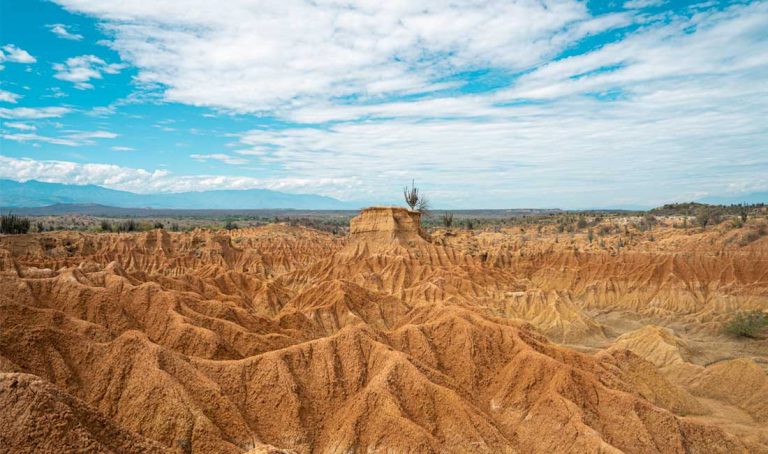
The Tatacoa Desert, also known as the Valley of Pain, is 38 km (23.6 miles) from Neiva.
This site is rich in fossils and is also home to a wide variety of animals such as rattlesnakes, eagles, spiders, lizards, scorpions and weasels.
The Tatacoa Desert is actually not a real desert, but a dry forest. Still, the Tatacoa Desert is considered one of the best spots in Colombia for stargazing. Therefore, there is also an observatory locally.
Archaeological Park of San Agustin
The Archaeological Park of San Agustin is 225 km (139 miles) from Neiva.
It covers an area of 50 square kilometers and is ideal for archeology lovers as it houses more than 500 statues representing a large part of pre-Columbian history.
The importance of this place is such that it was declared a World Heritage Site by UNESCO in 1995.
Betania Dam
The Betania Dam is located 38 km (23.6 miles) south of Neiva, on the road leading to the municipality of El Hobo.
This 7,000-hectare reservoir is very popular among tourists for various activities such as canoeing, skiing and of course fishing.
Cueva de los Guacharos National Natural Park
The Cueva de los Guácharos National Park is located 188 km (116.8 miles) south of Neiva, in the municipality of Acevedo.
The park was inaugurated in 1960 and is one of the 26 reserves with tourist use in Colombia. It was even the country’s first national nature park.
If you decide to visit this 9,000-hectare site, you can practice various ecotourism activities. These include hiking, camping, observation of fauna and flora, geological observation and bird watching. You can also find the guacharo, a bird discovered in 1979 by the German naturalist Alexander von Humboldt.
El Pailón thermal baths
Balneario El Pailon is 4 km (2.5 miles) from Neiva, on the road to Santa Maria.
If you decide to visit this place, you can enjoy nature by doing ecological hikes and of course enjoying the crystal-clear waters of the Bache river.
Palermo waterfalls
The Cascadas de Palermo are beautiful waterfalls 15 meters high located in the municipality of Palermo, 18 km (11 miles) from Neiva.
Best time to visit Neiva
The best time to visit Neiva is between May and September, when the weather conditions are more favorable to visit and enjoy the city’s various tourist attractions.
Also, between June and July, the most important events in the city take place, such as: B. the festivals of San Juan and San Pedro.
Events in Neiva
Here are the main events that take place in Neiva throughout the year that you should not miss.
Festivals of San Juan and San Pedro
The festivals of San Juan and San Pedro are the most important and traditional festivals of the people of Neiva.
During these festivals, which take place between June and July, various activities are carried out, such as B. Folk parades, parades, horseback riding and band courses.
Folk Festival and National Dominion of Bambuco
The Folklore Festival and National Reign of Bambuco is one of the most important events in Neiva, during which various activities such as parades, Reigns and musical performances take place.
The festival takes place annually for 15 days between June and July.
Neiva Film Festival CINEXCUSA
Neiva Film Festival CINEXCUSA is a thematic film festival that brings together various national and international guests such as writers, journalists, filmmakers and academics who share their knowledge and experiences.
Craft fair
The Crafts Fair is an event that brings together artists from the region, country and world to exhibit and sell their work, thereby strengthening the guild.
This fair takes place three times a year: the first at Easter, the second in June and the last in December.
International Meeting of Zanqueros “Cultura con Altura” (Culture with Altitude)
The International Meeting of Zanqueros “Cultura con Altura” is an event organized by the Athenea Association that brings together schools of artistic education from different countries and regions of Colombia every year.
Feast of the Immaculate Conception
The festival is a tribute to the Virgin of the Immaculate Conception celebrated every December 8th.
Feast of San Roque
The Feast of San Roque is a celebration that takes place in the village of El Caguán, in the municipality of Neiva, in honor of the patron saint of the place.
This festival takes place annually in August.
Neiva’s birthday
The founding of the city is celebrated on May 24th every year. Various artistic performances take place on this day.
Festival of the Yuma Magdalena River
This festival is an environmental event.
The Sirena del Rio is chosen as the main event.
In addition, there are various activities such as various extreme sports, plays, dance performances and folk music.
ExpoHuila
ExpoHuila is an event that brings together the smallest companies in the south of the country. That is why there are business conferences, lectures, business rounds, parades and of course product exhibitions.
This event takes place annually in November.
National Composition Competition “Jorge Villamil Cordobés”
The National Composition Competition “Jorge Villamil Cordobés” is a competition that pays tribute to one of the most representative composers of the Colombian Andean region.
This competition brings together the best amateur and professional composers in the Andean music category.
Nightlife in Neiva
Neiva has some incredible places to enjoy music and dancing, here are some of them.
PULL THE PLUG
Calle 21 # 5a-38
https://www.facebook.com/PULLTHEPLUGNEIVA/
PULL THE PLUG has good music, alcoholic drinks and the best snacks in town.
Disco Mayte
Calle 14 # 4-46
https://www.facebook.com/maytediscoteca/
If you like reggaeton, you can’t miss the Mayté Discoteca because it’s the meeting place for all lovers of this genre of music.
El Patio
Carrera 9 # 5-17
https://www.facebook.com/elpationeiva/
El Patio has good food and live music of all genres.
Typical food in Neiva
These are some of the typical dishes that you can find in the city of Neiva.
Asado Huilense
The Asado Huilense is one of the most traditional dishes in Neiva. It is made with pork, vinegar, onions, beer, garlic, orange juice, mint, basil, bay leaf, thyme, cilantro, nutmeg and oregano.
Goat stew
Estofado de Chivo is a dish made with goat meat, beer, cumin, onions, salt, garlic, rice, potatoes, tomatoes, carrots and peas.
Orejeperro Arepa
Arepa Orejeperro, also called Arepa de Angú, is prepared with threshed corn or rice, salted banana leaves, meat and bicarbonate.
Bizcochuelo
Bizcochuelo is made with flour, eggs, sugar, lemon zest and brandy.
Soperopo stew
Guiso Saperopo is a dish that includes sausage, beef, yellow potato, carrot, rice, onion, ahuyama, butter, oregano, and beans.
Bizcocho de Cuajada (quark cake)
Bizcocho de cuajada is made with eggs, corn, cottage cheese and salt.
Breaded tilapia fillet with Achira
Breaded tilapia fillet is a dish that essentially consists of a breaded fillet of achira de fortalecillas, coated in a chalupa sauce.
This dish is usually served with rice and a salad.
Cholupa juice
Jugo de cholupa is a juice made mainly from cholupa, an authentic fruit from the department of Huila that has a sweet and sour taste.
This juice is usually served with the typical dishes of the region.
Juan Valerio
Juan Valerio is a delicious dish made with plantains and pork rinds.
Tamal Huilense
The Tamal Huilense is basically a tamale made with corn dough, peas, rice, carrots, potatoes, peppers, chicken, beef, eggs, tomatoes, onions, pork and spices.
Chicken Sancocho
Sancocho de gallina is a dish made with chicken, arracacha, pastusa potatoes, plantains, yucca, ahuyama, Creole potatoes and peppers.
Lechona Huilense
Lechona Huilense is a dish that consists of fried peas and pork.
White corn cakes are usually served with this dish.
San Pedro cake
Pastel de San Pedro is a dish with fried meat, sausage, threshed corn, potatoes, soft yellow corn dough, and rice and pea stew.
Bizcocho de Achiras
Bizcocho de Achiras is made with Achira flour, cornmeal, fresh curd, eggs and butter.
Insulso
Insulso is a rice and whey dough sweetened with panela or sugar.
Masato Huilense
Masato Huilense is a leaf-wrapped dessert made from panela and rice.
Tender Corn Cob Cake
Pastel de Mazorca Tierna is a dish made with grated cheese, corn on the cob, chicken, butter, cream, salt, pepper and eggs.
Mistela
Mistela is a liqueur made from alcohol and aromatic herbs.
Neiva Accommodation Guide
Neiva seduces all visitors. From its historical richness to its captivating natural landscapes, it offers alternatives to satisfy the tastes of every type of traveler. Complement your lodging with your plans to make the most of this city full of history and natural beauty.
For more details on places to stay, check out our Neiva lodging blogs below:
How to get to Neiva
The city of Neiva is located about 320 kilometers from Bogotá, the capital of Colombia. There are several ways to get from Bogotá to Neiva.
Airplane
The quickest way to get to Neiva is by plane. Benito Salas Airport is connected to Bogotá and the main cities in the country. This airport is located in the north of Neiva, in Comuna 2.
You can fly with different airlines like Avianca or Latam.
The airlines that offer connections are as follows:
Bus
Neiva has a bus station at Carrera 7 No. 4-59, from where you can travel by bus with companies such as Cootranshuila, Coomotor and Rápido Tolima.
The journey takes about 6 hours.
The easiest way to buy tickets is via Pinbus.
By car
Another option is to travel by car, which takes between 5 and 6 hours, depending on traffic jams and speed.
Please note that you have to pay about 5 tolls on the route.
The following companies rent cars in Colombia:
- Hertz
- Avis
- ABC
Colombia Travel Guides
Here you will find travel guides for the most popular regions in Colombia, which we have put together during our extensive travels around the country.
- Colombia Travel Guide
- Bogota Colombia Travel Guide
- Medellin Colombia Travel Guide
- Cartagena Colombia Travel Guide
- Santa Marta Colombia Travel Guide
- Cali Colombia Travel Guide
- Coffee Triangle Colombia Travel Guide
- Barranquilla Colombia Travel Guide
- La Guajira Colombia Travel Guide
- Tayrona Park Colombia Travel Guide
- Palomino Colombia Travel Guide
- San Andres Island Colombia Travel Guide
- Providencia Island Colombia Travel Guide
- Casanare Llanos Colombia Travel Guide
- Amazonas Colombia Travel Guide
- Chocó Colombia Travel Guide
- Santander Colombia Travel Guide
- Boyaca Colombia Travel Guide
Travel Guides to Colombia’s Small Towns
Here you will find travel guides for less popular destinations in Colombia. Some of these destinations are even real insider tips and not even known to the Colombians as travel destinations.
- Aguachica Colombia Travel Guide
- Arauca Colombia Travel Guide
- Armenia Colombia Travel Guide
- Barrancabermeja Colombia Travel Guide
- Bucaramanga Colombia Travel Guide
- Buenaventura Colombia Travel Guide
- Canyon Chicamocha Colombia Travel Guide
- El Carmen de Bolivar Colombia Travel Guide
- Caucasia Colombia Travel Guide
- Cucuta Colombia Travel Guide
- Florencia Colombia Travel Guide
- Ibagué Colombia Travel Guide
- Inirida Colombia Travel Guide
- Ipiales Colombia Travel Guide
- Magangue Colombia Travel Guide
- Manizales Colombia Travel Guide
- Mitu Colombia Travel Guide
- Mocoa Colombia Travel Guide
- Monteria Colombia Travel Guide
- Neiva Colombia Travel Guide
- Palmira Colombia Travel Guide
- Pasto Colombia Travel Guide
- Pereira Colombia Travel Guide
- Popayan Colombia Travel Guide
- Puerto Asis Colombia Travel Guide
- Puerto Carreno Colombia Travel Guide
- Quibdo Colombia Travel Guide
- Riohacha Colombia Travel Guide
- San José del Guaviare Colombia Travel Guide
- Sincelejo Colombia Travel Guide
- Sogamoso Colombia Travel Guide
- Tulua Colombia Travel Guide
- Tumaco Colombia Travel Guide
- Tunja Colombia Travel Guide
- Turbo Colombia Travel Guide
- Valledupar Colombia Travel Guide
- Villa de Leyva Colombia Travel Guide
- Villavicencio Colombia Travel Guide
- Yopal Colombia Travel Guide
